Turn the vendor's playbook to your advantage
Vendor lifecycle service agreements are designed, priced, and renewed to benefit the vendor — not you. Having built and sold these programs for years, I know exactly where the margin sits, where the scope gaps hide, and which levers actually move a negotiation. I use that to help asset owners design service agreements that fit their plant, protect production, and stop overpaying.
How we help you
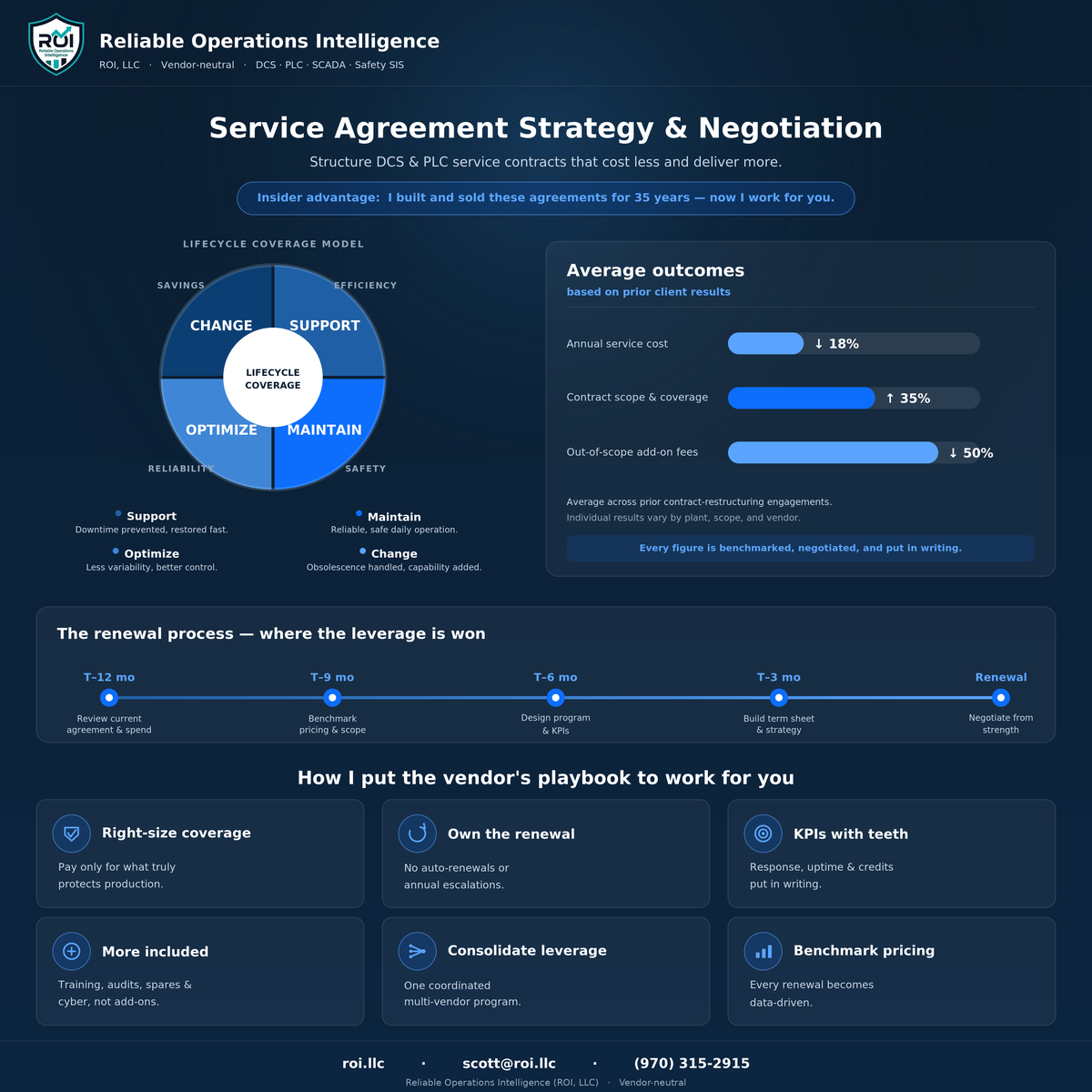
Right-size your coverage
Pay only for the support you actually need across the full lifecycle. Cut coverage you'll never use, and add the protection that truly safeguards production.
Own the renewal process
Replace auto-renewals and annual escalations with a structured renewal cycle, benchmarked pricing, and timing that keeps the leverage on your side of the table.
KPIs that hold the vendor accountable
Define the response times, uptime targets, deliverables, and reporting the vendor's team must meet for you — with service credits or penalties when they don't.
Get more included, not more billed
Fold training, system audits, remote administration, spares and warranty, cybersecurity patching, and alarm management into the agreement instead of paying for them as costly add-ons.
Consolidate for leverage
Combine fragmented single-year contracts into one coordinated program that increases your buying power across DCS, PLC, and SIS vendors.
Cost transparency & benchmarking
See what you're really paying per covered asset and how it compares, so every renewal becomes a data-driven negotiation instead of a rubber stamp.
The value report: your negotiation ammunition
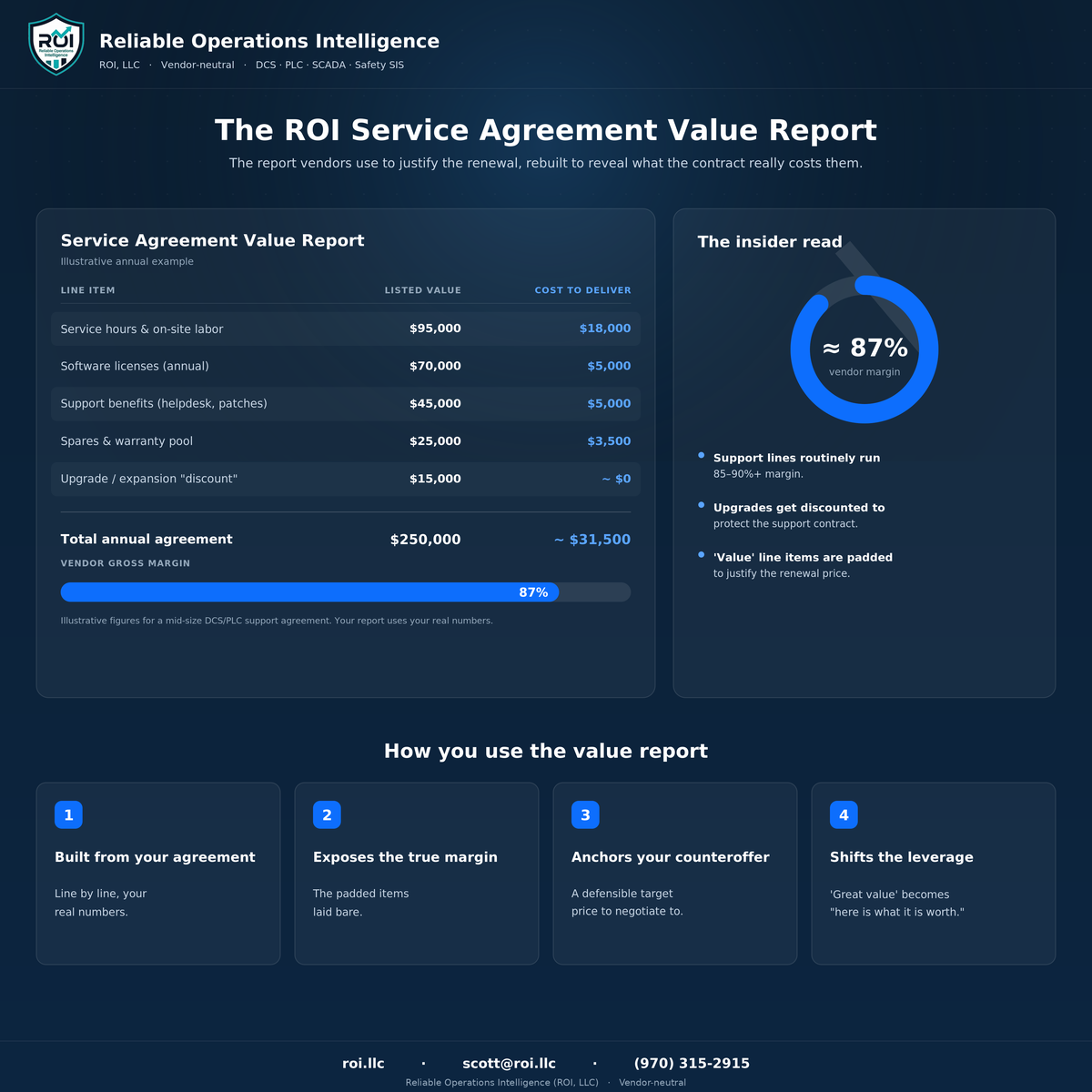
Vendors build a "value report" to justify the renewal — adding up service hours, software licenses, support benefits, and loyalty discounts until the price looks earned. I built these reports for years, from the inside. Now I rebuild them for you.
Working from your actual agreement, we itemize what you pay against what it realistically costs the vendor to deliver, line by line. The result is a clear, defensible picture of the margin baked into your contract — and it is not unusual for support agreements to carry more than 90% margin.
That last point is the leverage. Upgrades and expansions are often discounted heavily, not to save you money, but to protect a far more profitable support contract. Your value report puts the real numbers on paper and gives you a credible figure to anchor every counteroffer.
Your value report totals and tests every line of the agreement:
- Service hours and on-site labor cost
- Annual software license cost
- Support-contract benefit cost (helpdesk, patches, advisories)
- Annual discounts tied to the agreement, including upgrades and expansions
- A true-cost and margin summary you can take straight into the negotiation
A coverage map for any agreement
A well-built service agreement should address the entire system lifecycle. We map your current contract against these four domains and show you exactly where you're exposed — or overpaying.
| Lifecycle Domain | What it should cover | What it should deliver for you |
|---|---|---|
| Support | Telephone and product support, incident and problem management, defect tracking, technical advisories | Prevent downtime on minor issues and restore production quickly |
| Maintain | Parts and spares management, warranty, remote system administration, security scanning, preventative maintenance | Reliable, safe day-to-day operation with fewer surprises |
| Optimize | Alarm management, baseline audits, KPI measurement for safety, efficiency, performance, and reliability | Reduced variability and eliminated underperforming controls |
| Change | System migrations, expansions, test-bed validation, upgrades, new applications | Obsolescence addressed and new capability added on your timeline |
We can also help you build a single lifecycle assessment and baseline — turning proactive analysis into better budget planning and a stronger position at every renewal.
Industries we serve
The vendor playbook is the same wherever expensive, proprietary equipment comes with a mandatory service agreement. Process control (DCS & PLC) is my home base — and the same strategy travels to any owner of complex, vendor-serviced equipment.
Process Plants — DCS & PLC
Refining, petrochemical, LNG, and chemicals running Honeywell, Emerson, Yokogawa, and Rockwell service and lifecycle agreements. 25+ years of hands-on, insider experience.
Building Automation
Hospitals, campuses, airports, and commercial real estate on Honeywell, Johnson Controls, Siemens, or Schneider BAS/BMS service contracts — the same vendors, the same renewal traps.
Power & Utilities
Turbine Long-Term Service Agreements and plant SCADA/controls, where contracts run into the millions and rarely get benchmarked against the open market.
Water & Wastewater
Municipal SCADA, PLC, and integrator service agreements that seldom see an independent review — and where public budgets need every dollar defended.
How we work
Agreement & spend review
We review your current service agreements, scope, pricing, and performance history under a mutual NDA.
Design your target program
We design a right-sized lifecycle program with the coverage, KPIs, and terms that fit your plant and budget.
Negotiation support
We arm you with benchmarks, a target term sheet, and a clear strategy for your renewal or new agreement.
Want ongoing accountability? We can also provide vendor scorecards that track the agreed KPIs year over year, so the value holds up long after the ink dries.